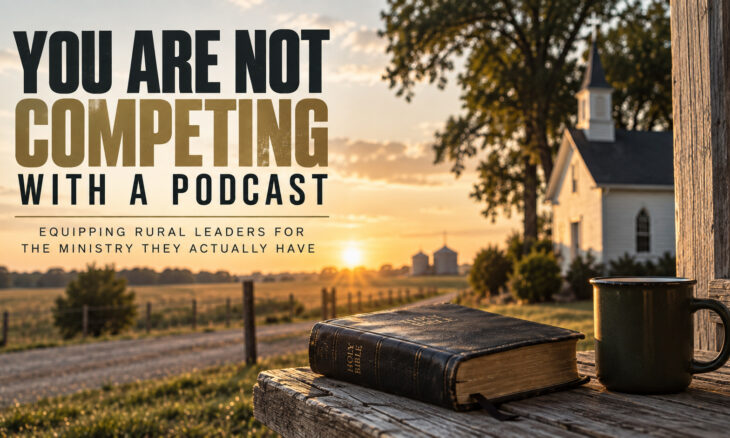
Equipping Rural Leaders for the Ministry They Actually Have
Introduction: The Elephant in the Room
Let’s talk about something almost nobody in the ministry conversation likes to discuss.
At any moment — on a Sunday morning, on a Tuesday commute, at the kitchen table after the kids are in bed — any member of your congregation can pick up their phone and listen to a sermon prepared by a team of college-educated academics, delivered by a six-figure professional communicator whose only job is to polish and perfect a thirty-minute message that will be delivered multiple times in a large-church context with a full production team behind it.
The lighting is perfect. The illustration research is thorough. The transitions are seamless. The humor lands. The theological depth is genuine. And it is available, for free, on demand, to every person in your congregation.
Now consider what you are working with.
You prepared your message in the margins of a full work week. You studied your text at the kitchen table after dinner, with the television on in the next room. You have no research team, no communications staff, no one to tell you that your third point is weak and your opening illustration is too long. You preached it to a small gathering of believers after a volunteer-led worship service, in a building that needs a new roof, on a sound system that occasionally feeds back at exactly the wrong moment.
And somewhere in the back of your mind, you cannot help but wonder, in the moments when discouragement gets the loudest, whether what you offer is good enough. Whether your people deserve better. Whether the gap between what they can access online and what you can deliver on Sunday morning is a gap that reflects something true about your limitations.
This article is written to address that discouragement directly and honestly. Not with platitudes. Not with the hollow reassurance that effort is what matters. But with a genuine, biblically grounded, practically equipped reorientation of what you are actually called to do — and why the things you bring to that calling are irreplaceable in ways that no professional communicator, however gifted, can replicate.
You are not competing with a podcast. And the sooner you understand why, the more freely and effectively you will minister.
The Comparison That Is Killing Rural Ministry
The comparison between the local rural minister and the professional orator is not just discouraging. It is categorically unfair because it is comparing two entirely different things as though they are the same thing.
The large-church, professionally produced sermon is a communication event. It is designed to be excellent communication — clear, compelling, well-illustrated, emotionally resonant, broadly applicable. It is produced by professionals for a mass audience and optimized for engagement. In its category, it is often genuinely excellent.
But the local church sermon — and more broadly, the local church ministry — is not primarily a communication event. It is a discipleship event. And discipleship is something that celebrity preaching, for all its excellence, fundamentally cannot do.
Here is what discipleship requires that a podcast cannot provide:
Presence. The rural minister who sits with a dying man in his final hours, who stands at a graveside in February wind, who shows up at the hospital at 2 a.m. — that shepherd is doing something that no downloaded sermon can do. He is being present. And presence, in the economy of discipleship, is irreplaceable.
Knowledge of the person. The professional communicator preaches to an abstraction — a generalized audience he has never met and will never know. The rural minister preaches to people whose names he knows, whose marriages he has counseled, whose children he has watched grow up, whose fears and hopes and failures and triumphs have been shared with him in real relationship. That knowledge makes possible a quality of pastoral application that no amount of professional polish can replicate.
Accountability and relationship. The podcast listener has no relationship with the voice in their earbuds. There is no mutual accountability, no shared history, no one who will notice if they are absent, no one who will ask the hard question at the right moment. The local church, with its imperfect preacher and its small congregation and its roof that needs replacing, offers something the podcast simply cannot: the irreplaceable accountability structure of a covenant community.
The long view. The celebrity preacher sees his audience for thirty minutes. The rural leader sees his congregation across decades — through seasons of faith and doubt, through life transitions and family crises, through the long, slow, often invisible work of character formation that is the actual substance of discipleship. That long-view relationship is where the most significant spiritual formation happens. And it belongs exclusively to the local minister.
The comparison, when seen clearly, is not between a lesser version of the same thing and a greater version. It is between two entirely different things. One is a communication product. The other is a life poured out in service of specific people in a specific place over a long period of time.
You are not competing with a podcast. You are doing something a podcast cannot do.
What Your “Normal” Life Actually Brings to Ministry
Here is something the professional communicator does not have — and cannot acquire regardless of how much his budget increases or how skilled his research team becomes.
A normal life.
The rural minister who also farms, teaches school, works in construction, drives a truck, or manages a small business brings something to his ministry that is genuinely rare and genuinely powerful: the credibility of a life lived in the same world as the people he serves.
When he preaches about anxiety, his congregation knows he has felt it — not as a theoretical concept to be illustrated with a borrowed anecdote, but as the actual weight of a payroll that has to be met, a crop that needs rain, a job that might not be there next month. When he teaches about marriage, he is not drawing on research about marriage — he is living one, with the same pressures and temptations and ordinary graces that his congregation’s marriages navigate. When he talks about faith in the middle of uncertainty, he is talking from the inside of the same uncertain world his people inhabit.
This is not a consolation prize for the lack of professional training. It is a genuine and significant ministry asset. Paul was a tentmaker. The disciples were fishermen and tax collectors. The ordinary vocational lives of the men Jesus chose were not obstacles to their ministry — they were part of the texture of it. The people they reached recognized them as neighbors, as people from the same world, whose faith had been tested in the same fires.
The professional communicator, for all his gifts, often cannot say this. He inhabits a world of church staffs and ministry conferences and book deals that is genuinely foreign to the farmer in your third row. His illustrations are borrowed. His applications are general. His credibility is built on expertise, not shared experience.
Your credibility is built on something different — and in many ways deeper. You are one of them. And that is a gift that no amount of professional training can manufacture.
The Biblical Case for the Equipped Local Leader
The New Testament vision of church leadership is not primarily a vision of professional expertise. It is a vision of character, faithfulness, and the Spirit-empowered ability to handle the Word of God and care for the people of God.
What Paul Actually Required of Leaders
The qualifications Paul gives for elders and overseers in 1 Timothy 3 and Titus 1 are striking in what they emphasize and what they do not. He does not require a seminary degree. He does not require professional communication skills. He does not require a large platform or a proven track record of growing a congregation.
He requires a life of integrity. A well-ordered household. Hospitality. Self-control. A good reputation in the community. And one skill — the ability to teach. Not brilliance. Not polish. The ability to handle the Word of God faithfully and communicate it to others.
“He must hold firm to the trustworthy word as taught, so that he may be able to give instruction in sound doctrine and also to rebuke those who contradict it.” (Titus 1:9)
Hold firm to the trustworthy word. Give instruction in sound doctrine. This is the bar. It is a serious bar — it requires genuine engagement with Scripture and genuine theological understanding. But it is not the bar of professional communication excellence. It is the bar of faithful, grounded, doctrinally sound teaching in the context of a life that embodies what is being taught.
The Apollos Problem — and Its Resolution
Acts 18 gives us an instructive case study in the relationship between training, giftedness, and effective ministry. Apollos was a gifted communicator, “eloquent” and “competent in the Scriptures,” but he had an incomplete understanding of the gospel. When Priscilla and Aquila heard him, they did not dismiss him or replace him. They “took him aside and explained to him the way of God more accurately.” (Acts 18:26)
The resolution to incomplete training is not despair or withdrawal — it is the humble pursuit of greater accuracy in handling the Word, received through relationship and community. Apollos became more effective not by becoming more polished but by becoming more theologically grounded.
This is the model for the rural leader who feels under-equipped: not the pursuit of professional excellence for its own sake, but the humble, consistent, relational pursuit of greater faithfulness to the Word.
The Sufficiency of the Spirit
Paul’s confidence in the Corinthian church — a congregation he describes as not having “many wise according to worldly standards, not many powerful, not many of noble birth” (1 Corinthians 1:26) — was not confidence in their credentials. It was confidence in the power of God working through weakness.
“And I, when I came to you, brothers, did not come proclaiming to you the testimony of God with lofty speech or wisdom. For I decided to know nothing among you except Jesus Christ and him crucified. And I was with you in weakness and in fear and much trembling, and my speech and my message were not in plausible words of wisdom, but in demonstration of the Spirit and of power, so that your faith might not rest in the wisdom of men but in the power of God.” (1 Corinthians 2:1-5)
The rural leader who preaches with genuine faith, genuine knowledge of the Word, and genuine love for his people — in weakness, without the support structures of professional ministry — is in extraordinarily good biblical company. The power that changes lives is not the power of excellent communication. It is the power of the Spirit working through a vessel that has been emptied of self-reliance.
Practical Pathways to Growth
None of this is an argument against growth, learning, or the pursuit of greater theological depth. Quite the opposite. The rural leader who is content with where he is theologically is not honoring the charge to “do your best to present yourself to God as one approved, a worker who has no need to be ashamed, rightly handling the word of truth.” (2 Timothy 2:15)
The question is not whether to grow — it is how to grow within the real constraints of rural bi-vocational life. Here are practical pathways that are actually accessible.
Structured Online Learning
The explosion of online theological education over the past decade has been genuinely transformative for rural ministry. Courses that were once available only to residential seminary students are now accessible on a phone, on demand, at whatever pace a bi-vocational schedule allows.
Many of these resources are free or low-cost. Platforms offering structured biblical and theological courses — covering hermeneutics, biblical theology, church history, pastoral ministry, and more — have made serious theological education available to the rural elder in a way that previous generations could not have imagined.
The key is structure and consistency. Casual consumption of theological content is valuable but limited. A rural leader who commits to working through one structured course per year — with genuine engagement, note-taking, and application — will develop a theological foundation that transforms his ministry over time.
Intentional Reading
The most accessible and affordable form of ongoing theological education is still the book. A rural minister who reads two or three carefully chosen books per year — one biblical/theological, one pastoral/practical, one biographical — will develop a depth of understanding that compounds significantly over a ministry lifetime.
The key word is intentional. Reading randomly produces random growth. Reading with a plan — working through the theology of a particular book of Scripture, or a key doctrine, or the history of a particular period of the church — produces the kind of cumulative, structured understanding that equips a minister for the full range of what his calling demands.
Recommendations do not require a curated library. A trusted mentor, posted bible college courses, or even the reading list of a respected theologian can provide a starting point. The investment of thirty minutes per day in intentional theological reading will produce, over a decade of ministry, a depth of preparation that rivals many formal programs.
Peer Learning Communities
One of the most underutilized resources available to rural leaders is each other. The network of bi-vocational and rural ministers within driving distance of any rural church represents a significant collective reservoir of experience, wisdom, and theological reflection — almost entirely untapped.
A monthly gathering of three to five rural ministers to study a passage together, discuss a theological question, share a pastoral challenge and receive counsel, pray for one another provides the kind of mutual accountability and peer learning that formal education at its best is designed to produce. Without the tuition. Without the commute. With the added benefit of people who understand the specific texture of rural ministry because they are living it.
If such a network does not exist near you — build one. Reach out to two or three other leaders in your county or region. Propose a simple, regular gathering with a modest agenda. The investment is small. The return, over time, is significant.
Mentorship — Giving and Receiving
The Timothy model is not only relevant for developing the next generation of leaders. It is a model for the ongoing formation of the current generation as well.
Every rural leader needs someone further along the road who is willing to invest in them — to answer questions, to read and respond to sermons, to provide the kind of honest, experienced feedback that formal education at its best provides. Identifying and pursuing a mentoring relationship — even an informal one, even conducted primarily by phone or video — is one of the highest-return investments a rural minister can make in his own development.
And every rural leader who has been in ministry for more than a few years has something worth passing on to someone coming up behind them. The act of mentoring another leader is itself a form of theological formation — there is nothing quite like having to articulate and defend what you believe to someone who is genuinely asking in order to discover how well you actually understand it.
Redefining the Win
The deepest shift this article is attempting to produce is not a change in technique. It is a change in the definition of success.
The professional ministry world measures success in attendance, reach, and production quality. These are not meaningless metrics, but they are incomplete ones, and they are particularly misleading when applied to the rural ministry context.
The rural church is not in the business of producing excellent religious content for a large audience. It is in the business of making disciples, of seeing specific people, in a specific place, formed into the image of Christ over the long arc of a faithful life.
That work does not require a production team. It requires presence, faithfulness, genuine love, and a deep enough knowledge of the Word to feed the people God has entrusted to your care.
Jesus did not say “go and build large attendances to watch excellent religious performances.” He said “go and make disciples.” The metrics of discipleship — transformed character, genuine faith, love for God and neighbor that persists through the seasons of life — do not show up in a weekend attendance report. They show up in a life. In a marriage restored. In a young person who carries their faith into the world. In an elderly member whose death is marked by the peace of a life well-lived in the presence of God.
These are the wins of rural ministry. They are not visible on a platform. They are visible to God — and to the small community of people who have been changed by the faithful, unglamorous, irreplaceable work of a local minister who knew their name and loved them over the long haul.
That is not a lesser form of ministry. It is the truest form of it.
“Do your best to present yourself to God as one approved, a worker who has no need to be ashamed, rightly handling the word of truth.” — 2 Timothy 2:15
Approved by God. Not by the algorithm. Not by the attendance report. Not by the comparison with whoever has the most downloaded podcast this week.
Approved by God. That is the standard. And it is a standard every faithful rural leader — equipped, growing, present, and genuinely loving their people — is fully capable of meeting.
The Rural Church Network exists to equip and encourage those who serve “out here.” For more resources, sermon series, and pastoral encouragement, visit ruralchurch.net.